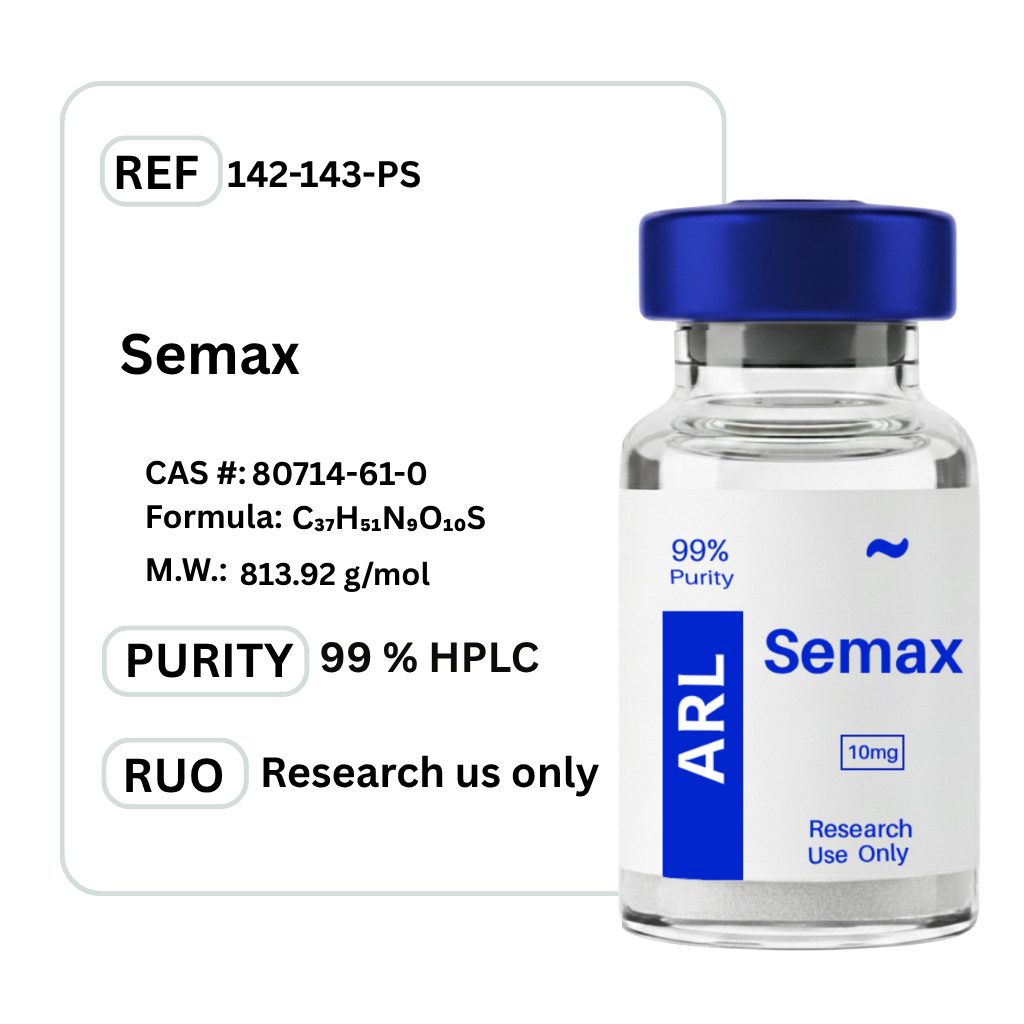
Semax
Semax
This batch of Semax Nootropic Peptide has been third party lab tested and verified for quality.
Contents: Semax
Form: Powder
Purity: 99.0%
Couldn't load pickup availability
Free Reconstitution Solution automatically added to your cart with each order.
| Made & Shipped From Canada
Verified+

Adaptive Stress Response Agent: Product Focus
Overview and Introduction
The Adaptive Stress Response Agent (ASRA) is a novel product focused on enhancing the biological system's resilience to various forms of physical and mental stress. Leveraging a foundation in adaptogenic peptides, ASRA is designed for use in controlled research environments, particularly for in vivo stress adaptation assays. This document provides a comprehensive overview of the product's scientific background, mechanism of action, intended use, and specifications.
The ability of an organism to adapt and maintain homeostasis under challenging conditions is critical for survival. Stressors, whether environmental (e.g., hypoxia, extreme temperatures) or psychological, trigger complex physiological responses that, while necessary in the short term, can lead to systemic dysfunction and reduced performance when prolonged or severe. ASRA aims to modulate these responses at a genetic and functional level, promoting a more balanced and adaptive state.
Scientific Background
The core scientific principle behind the Adaptive Stress Response Agent is rooted in the adaptogenic properties of the neuropeptide Semax. Semax is a synthetic heptapeptide derived from a fragment of Adrenocorticotropic Hormone (ACTH), specifically ACTH(4-10) Pro-Gly-Pro. It has been extensively studied for its potential in promoting stress resistance and enhancing cognitive function.
Mechanism of Action: The Adaptogenic Pathway
Semax is classified as an adaptogen due to its ability to non-specifically increase resistance to various stressors without causing significant side effects. Its mechanism is multifaceted, involving both genomic and non-genomic pathways.
Gene Expression Regulation
One of the most significant findings regarding the activity of the peptide is its profound impact on gene expression. This is critical for the long-term, adaptive response to stress.
- Immune and Vascular Response: The peptide regulates the expression of genes involved in the immune and vascular response to stress. This includes genes related to inflammation, tissue repair, and vascular permeability. By modulating these genes, the agent helps mitigate the damaging effects of a hyper-inflammatory or dysregulated vascular response often seen under chronic stress.
- Neurotrophic Factors: It is known to increase the expression of brain-derived neurotrophic factor (BDNF), a key molecule involved in neuronal plasticity, survival, and differentiation. This contributes directly to the maintenance of cognitive function under stress.
Cellular and Molecular Effects
Beyond gene regulation, the agent exhibits several direct physiological effects that underpin its stress-protective function.
Area of Effect
Biological Result
Relevance to Stress Adaptation
Neuroprotection
Increased survival of neurons; reduced excitotoxicity
Protects the central nervous system from damage induced by severe stress (e.g., ischemia, hypoxia)
Neurotransmitter Modulation
Modulates levels of monoamines (e.g., dopamine, serotonin)
Contributes to improved mood, focus, and reduced anxiety under mental stress
Antioxidant Activity
Scavenging of reactive oxygen species (ROS)
Reduces cellular damage and oxidative stress often exacerbated by physical endurance tasks
Performance and Endurance Enhancement
A key characteristic of an effective adaptogen is its ability to help maintain optimal function under extreme conditions.
- Cognitive Function: Under conditions of severe physical and mental load, such as prolonged work, sleep deprivation, or psychological distress, the agent helps to maintain cognitive function, including attention, processing speed, and memory recall.
- Physical Performance: Studies indicate that the agent assists in maintaining physical performance, particularly under environmental extremes like hypoxia (low oxygen) or temperature extremes. This is attributed to improved cellular oxygen utilization and reduced metabolic stress.
Safety Profile and Cortisol Management
Unlike its parent molecule, Adrenocorticotropic Hormone (ACTH), the Adaptive Stress Response Agent (Semax) does not significantly spike systemic cortisol levels.
- Avoiding Hormonal Side Effects: This is a crucial distinction. ACTH directly stimulates the adrenal glands to release cortisol, the primary stress hormone. While essential for acute response, chronically elevated cortisol levels lead to well-documented side effects, including immune suppression, muscle wasting, and metabolic disturbances.
- Targeted Regulation: The agent appears to engage the adaptive mechanisms of the stress response pathway (e.g., gene regulation, neurotrophic support) without triggering the high-level, systemic hormonal cascade associated with chronic stress, offering a safer profile for long-term physiological modulation.
Physiological Stress Response Pathway
The following visual representation illustrates the key physiological pathways involved in the stress response and the proposed points of modulation by the Adaptive Stress Response Agent.
The agentβs intervention is designed to steer the body away from a purely catabolic, high-cortisol state toward a more balanced, homeostatic, and resilient adaptation.
Usage and Experimental Protocols
The Adaptive Stress Response Agent is exclusively intended for use in controlled in vivo stress adaptation assays within accredited research facilities. The primary objective is to evaluate its efficacy in mitigating stress-induced deficits across various physiological and cognitive domains.
Suggested Applications
- Hypoxia Models: Studying the preservation of cognitive and physical performance in models subjected to low-oxygen environments.
- Thermal Stress Assays: Evaluating the agentβs ability to maintain homeostatic stability and endurance under extreme heat or cold conditions.
- Chronic Mild Stress (CMS) Models: Assessing the neuroprotective and mood-stabilizing effects in animal models of depression or anxiety induced by long-term, unpredictable stressors.
- Forced Swim/Treadmill Tests: Measuring improvements in physical and behavioral endurance metrics.
Administration and Dosage
Specific dosage and administration routes will be determined by the lead researcher based on the model species and the goals of the study.
Parameter
Recommended Guidance
Notes
Route of Administration
Intranasal or Subcutaneous
Intranasal administration is often preferred in research due to the agent's neuropeptide nature and desired central nervous system action.
Model Species
Mouse, Rat, Primate
The research model must be appropriate for the specific stressor being applied.
Research Protocol
Detailed protocols are available in the File
Consult the file for specific stressor application and assessment metrics.
All experimental use must strictly adhere to institutional guidelines and ethical standards for animal research.
Product Specifications
Formulation and Handling
The Adaptive Stress Response Agent is supplied as a lyophilized powder.
Component
Specification
Agent Name
Adaptive Stress Response Agent
Scientific Name
Semax (ACTH 4-10 Pro-Gly-Pro)
Purity
>98% (HPLC)
Appearance
White lyophilized powder
Storage (Unreconstituted)
-20Β°C (Freezer)
Storage (Reconstituted)
2Β°C - 8Β°C (Refrigerated)
Reconstitution Solvent
Bacteriostatic Water or Sterile Saline
Reconstitution Protocol
- Allow the vial to reach room temperature before opening.
- Carefully inject the appropriate volume of reconstitution solvent (Bacteriostatic Water or Sterile Saline) into the vial, aiming the liquid at the side of the glass.
- Do NOT shake the solution. Gently swirl the vial until the powder is fully dissolved.
- Once reconstituted, store the solution at 2Β°C - 8Β°C. Shelf-life of the reconstituted solution must be validated by the research team but typically does not exceed 30 days.
Comprehensive Literature Review
The efficacy and mechanisms of the core agent (Semax) have been documented across numerous studies. This section summarizes key findings relevant to its use as an Adaptive Stress Response Agent.
Study 1: Gene Expression Under Stress
Focus: Molecular changes in response to acute immobilization stress.
Key Findings: Administration of the agent before stress exposure significantly normalized the expression levels of stress-responsive genes in the hippocampus and cerebral cortex. Specifically, the expression of genes related to inflammatory cytokines (e.g., IL-6) and vascular integrity was restored to near-baseline levels, suggesting a protective, gene-regulating effect against stress-induced systemic disruption.
Study 2: Cognitive Maintenance in Hypoxia
Focus: Impact on learning and memory under hypoxic conditions.
Key Findings: Rodents treated with the agent maintained significantly higher scores in spatial memory tests (e.g., Morris Water Maze) when subjected to simulated high-altitude (hypoxic) conditions compared to controls. This effect was directly correlated with increased BDNF levels in the brain regions associated with memory and learning, supporting the role of the agent in preserving higher-order brain function under physiological duress.
Study 3: Physical Endurance and Temperature Stress
Focus: Performance during exposure to extreme temperatures.
Key Findings: Subjects demonstrated prolonged physical working capacity and reduced signs of metabolic exhaustion when pre-treated with the agent and exposed to both extreme cold and heat protocols. The mechanism was hypothesized to involve enhanced mitochondrial function and improved thermoregulatory efficiency.
Safety and Regulatory Compliance
Research Use Only
WARNING: The Adaptive Stress Response Agent is strictly for Research Use Only and is not intended for human consumption or therapeutic use. All handling and disposal must comply with established laboratory safety protocols.
Material Safety Data Sheet (MSDS)
A complete Material Safety Data Sheet (MSDS) is provided in the supplemental materials File and must be reviewed by all personnel handling the product. Key safety points include:
- Hazard Identification: Non-toxic under normal handling conditions. Avoid inhalation of lyophilized powder.
- First Aid Measures: In case of contact, flush eyes or skin immediately with large amounts of water.
- Spill Procedures: Absorb liquid spills with inert material and place in a container for chemical waste disposal.
Ethical Considerations
Any study utilizing the Adaptive Stress Response Agent must obtain full approval from the appropriate Institutional Animal Care and Use Committee (IACUC) or equivalent body. Researchers are responsible for minimizing stress and suffering in all experimental subjects, in line with the highest standards of ethical research.
Future Research Directions
The current product focuses on a broad adaptive response. Future research is encouraged to investigate more specific applications, including:
- Tissue-Specific Adaptogenics: Delineating the agent's impact on stress-related gene expression in specific organs (e.g., heart, liver, adrenal glands).
- Synergistic Compounds: Testing the agent in combination with other known adaptogens or pharmaceuticals to identify synergistic effects that could further enhance stress resilience.
- Mechanism of Cortisol Bypass: Deeper investigation into the exact molecular pathway that allows the agent, a derivative of ACTH, to achieve its effects without inducing a significant, negative spike in circulating cortisol. This is a crucial area for understanding targeted stress modulation.
Ordering and Contact Information
For inquiries regarding pricing, bulk orders, or technical support, please contact our research sales team.
Department
Contact Method
Details
Sales
Email: sales@Person.com
For pricing and bulk order quotes
Technical Support
Phone: (555) 555-5555
For assistance with reconstitution or protocol design
Location
Place
Research facility address
All orders require valid institutional verification and a signed research agreement.
Appendix: Detailed Gene Targets
The following table lists some of the known gene families and specific targets implicated in the Adaptive Stress Response Agentβs mechanism of action. This information is provided for advanced molecular biology assay design.
Gene Family
Function in Stress Response
Predicted Modulation by ASRA
Neurotrophins
Neuronal survival, plasticity, and repair
Upregulation (e.g., BDNF, NGF)
Cytokines/Inflammatory Mediators
Immune response and inflammation
Downregulation (e.g., IL-6, TNF-alpha)
Heat Shock Proteins (HSPs)
Cellular protection against protein damage
Upregulation (e.g., HSP70)
Vascular Endothelial Growth Factors (VEGF)
Angiogenesis and vascular integrity
Modulation (typically normalization/stabilization)
This appendix serves as a starting point for investigators designing targeted gene expression studies using RT-PCR or microarray techniques to confirm the molecular mechanisms in situ.
Research Events and Conferences
Researchers interested in the Adaptive Stress Response Agent are encouraged to attend the following upcoming events where data and protocols related to this product will be presented.
- Global Stress Physiology Symposium
- Date: Date
- Event Details: Calendar event
- Neuroplasticity and Adaptogen Conference
- Date: Date
- Event Details: Calendar event
Final Statement
The Adaptive Stress Response Agent represents a significant advancement in the study of adaptogenic peptides and targeted stress modulation. It offers a powerful tool for researchers seeking to understand and enhance biological resilience to a wide spectrum of physical and mental challenges. We are committed to supporting the scientific community in utilizing this product to advance the fields of physiology, neurobiology, and performance science.
(This page is intentionally left blank for protocol notes.)
(This page is intentionally left blank for data recording.)
(This page is intentionally left blank for analytical results.)
Add your product information here. This content will appear when this tab is selected.
Excellent 4.6 | Verified reviews
Tested. Verified. Trusted.
We take a laboratory-first approach to quality. Each batch is made under controlled conditions and verified by an independent lab (HPLC/MS). We only ship batches that test β₯99% purity, and we provide a full COA, including identity, methods, and chromatograms, for your review.
Shop now
-

FAST DELIVERY
Enjoy fast and reliable 3β5 day shipping.
-

HIGHEST QUALITY PEPTIDES
Our products are scientifically formulated and manufactured in cGMP-compliant facilities.
-

Dedicated Customer Service
Our customer service team is highly knowledgeable in peptide research and its applications. Weβre available 24/7 to assist you.