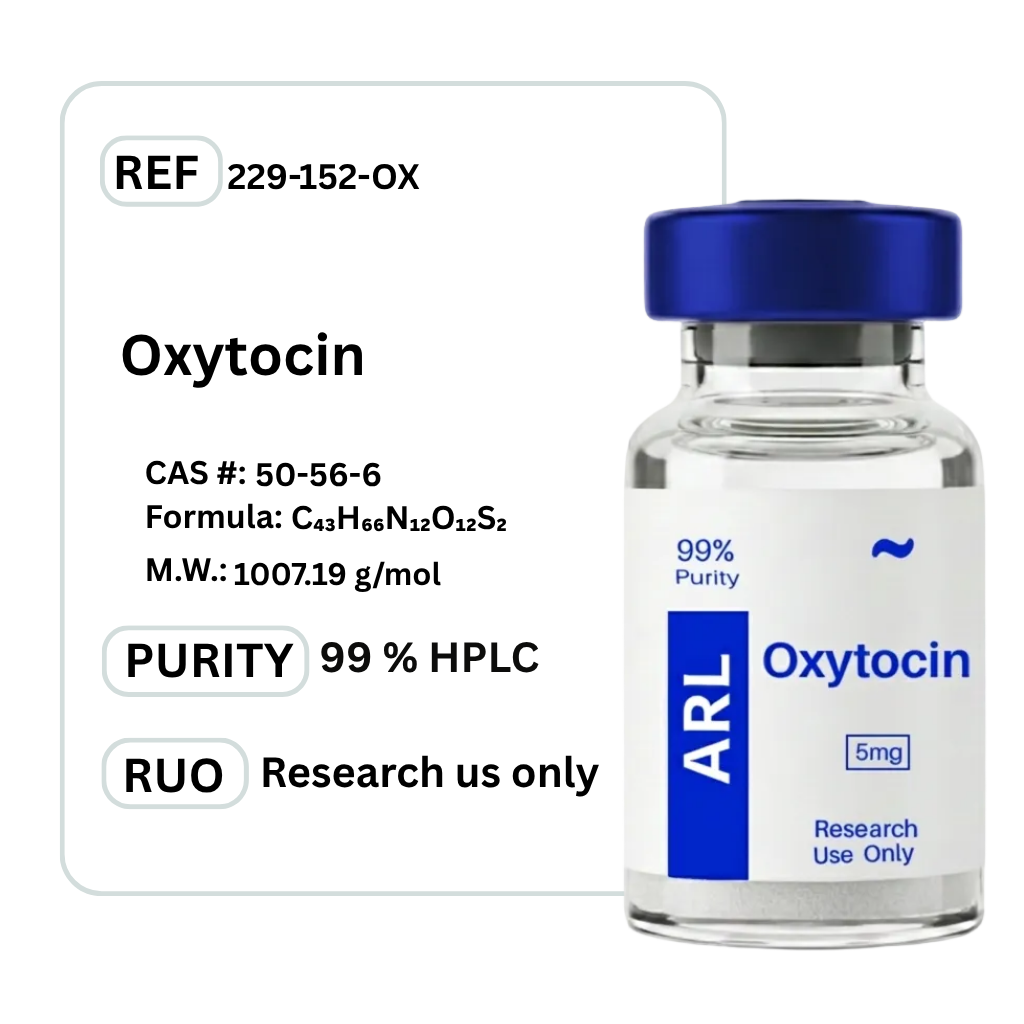
Technical Guide: Stabilized Oxytocin Peptide (Lyophilized)
Introduction
This guide provides comprehensive instructions for laboratory managers and research personnel on the proper handling, storage, and reconstitution of the Stabilized Oxytocin Peptide (Lyophilized) product. Adherence to these protocols is essential for maintaining the high purity and biological activity of the peptide, thereby ensuring the reliability and consistency of research results.
Product Highlights
Stabilized Oxytocin Peptide is a synthetic cyclic nonapeptide recognized for its high purity and consistent receptor binding affinity. Oxytocin, a key neurohypophysial hormone, plays a critical role in various physiological and behavioral processes, making the quality of the research material paramount. This product is synthesized under stringent quality control to meet the demanding requirements of advanced laboratory research.
Section 1: Storage Best Practices
Maintaining the stability of lyophilized and reconstituted peptide is crucial for the integrity of the research. This section details the recommended conditions for short-term and long-term storage to prevent degradation and loss of function.
1.1 Lyophilized (Powder) Storage
The lyophilized form of the Stabilized Oxytocin Peptide offers inherent stability, but specific conditions must be met for optimal shelf-life.
Duration
Temperature
Condition Notes
Short-Term
Room Temperature (15-25°C)
Stable for 3-4 months. Ensure packaging is sealed and protected from light and moisture.
Long-Term
Ultra-Low Temperature (-80°C)
Recommended for storage beyond 4 months. Preserves maximum biological activity and purity.
Key Considerations for Lyophilized Storage:
- Moisture Control: Lyophilized peptides are highly hygroscopic. Always ensure the product container is tightly sealed.
- Light Exposure: Store in the original opaque container or a dark environment to minimize photo-degradation.
- Temperature Cycling: Minimize the number of times the product is removed from -80°C storage. Allow the vial to warm up to room temperature before opening to prevent condensation, which introduces moisture.
1.2 Reconstituted (Liquid) Storage
Once reconstituted, the peptide's stability is significantly reduced, necessitating colder storage and timely usage.
Duration
Temperature
Condition Notes
Use Period
Refrigerated (2-8°C)
Use within 30 days of reconstitution. Peptide integrity may decline rapidly after this period.
Recommended Reconstitution Solvent:
- For standard laboratory use, bacteriostatic water (sterile water with 0.9% benzyl alcohol) is recommended to inhibit microbial growth during the 30-day usage window.
Section 2: Reconstitution Protocol
Accurate and sterile reconstitution is critical to obtaining a functional peptide stock solution.
2.1 Materials Required
- Stabilized Oxytocin Peptide (Lyophilized)
- Sterile Bacteriostatic Water or desired solvent (e.g., physiological saline, buffer)
- Sterile syringes and needles
- Sterile microcentrifuge tubes or storage vials for aliquoting
2.2 Reconstitution Steps
- Preparation: Allow the lyophilized peptide vial to warm to room temperature in a desiccator or dry environment. This step typically takes 30-60 minutes. Do not open the vial while cold.
- Solvent Calculation: Determine the precise volume of solvent required to achieve the desired stock concentration.
- Sterile Addition: Aseptically add the calculated volume of solvent to the lyophilized peptide vial. Direct the stream of the solvent onto the side wall of the vial, not directly onto the powder, to ensure gentle dissolution.
- Dissolution: Gently swirl the vial to aid in dissolution. Do not shake vigorously, as this can induce oxidation and damage the peptide's disulfide bridge, leading to loss of biological activity. Most peptides will dissolve quickly. If minor powder remains, gentle sonication (bath sonicator) for a few seconds may be used, but this is usually unnecessary for high-purity oxytocin.
- Inspection: Visually inspect the solution to ensure complete dissolution. The final solution should be clear and colorless.
Section 3: Aliquotting and Handling
The single most destructive process to peptide integrity in a lab setting is the freeze-thaw cycle. Proper aliquoting is the primary defense against this.
3.1 The Danger of Freeze-Thaw Cycles
The Stabilized Oxytocin Peptide contains a critical disulfide bridge (Cys1-Cys6) essential for its cyclic structure and biological activity. Repeated freezing and thawing can cause physical stress (shear forces) and promote local concentration changes and oxidation, leading to the breakage or modification of this bridge, thereby rendering the peptide inactive.
3.2 Aliquotting Procedure
- Volume Selection: Aliquot the stock solution into small, single-use volumes that correspond to a typical experiment or assay. The aliquot volume should be sized so that it is used completely once thawed.
- Vial Selection: Use sterile, low-binding microcentrifuge tubes (e.g., polypropylene) to minimize the loss of peptide to the container walls.
- Storage: Immediately transfer the aliquoted solutions to the recommended storage temperature (-80°C). Flash-freezing in a dry ice/ethanol bath before placing at -80°C is optional but recommended to minimize crystal formation.
Action
Recommendation
Rationale
Aliquot Volume
Single-use size
Minimizes waste and avoids multiple freeze-thaw cycles.
Freezing
Quick freeze (e.g., -80°C)
Reduces time at intermediate temperatures, minimizing degradation.
Thawing
Quick thaw on ice
Maintains stability and minimizes time at higher temperatures.
Refreezing
NEVER refreeze a thawed aliquot.
Prevents damage to the disulfide bridge and loss of activity.
Section 4: Specifications and Quality Control
The quality of the Stabilized Oxytocin Peptide is verified through rigorous analytical methods to ensure high performance in research applications.
4.1 Product Specifications
Specification Parameter
Value
Analytical Method
Purity
>98%
High-Performance Liquid Chromatography (HPLC)
Molecular Weight
1007.19 Da (Monoisotopic)
Mass Spectrometry (MS)
Solubility
Soluble in water and saline
Visual/Dissolution Test
Appearance
White crystalline powder
Visual Inspection
Biological Activity
High, consistent receptor binding
In vitro/In vivo Assay (Internal Testing)
4.2 Handling Contamination
To maintain the specified purity:
- Aseptic Technique: All handling, especially reconstitution and aliquoting, must be performed under strict aseptic conditions (e.g., in a laminar flow hood).
- Solvent Purity: Use only high-grade, sterile, and validated solvents.
Section 5: Usage and Safety
5.1 Intended Use
This product is for Laboratory Research Use Only. It is strictly not intended for human use, diagnostic procedures, or therapeutic applications.
5.2 Safety Data Sheet (SDS)
A complete Safety Data Sheet is available for download at the product page on the supplier's website. Lab managers must ensure all personnel handling this peptide have reviewed the SDS and follow standard laboratory safety practices.
Required Documentation:
Please keep the product Certificate of Analysis (File) on file alongside this guide.
Section 6: Troubleshooting Guide
This section addresses common issues encountered during the handling and use of lyophilized peptides.
Symptom
Potential Cause
Recommended Action
Peptide does not dissolve completely after gentle swirling.
Peptide clumping, inadequate solvent volume, or poor-quality solvent.
Ensure correct solvent volume is used. Gently heat (no more than 37°C) for 5 minutes or use brief bath sonication (5 seconds).
Stock solution appears cloudy or discolored.
Contamination (microbial or chemical) or product degradation (oxidation).
Discard the solution. Review reconstitution steps to ensure sterile technique and high-purity solvent.
Loss of biological activity after storage.
Repeated freeze-thaw cycles or storage at incorrect temperature.
Ensure proper aliquoting was performed. Verify freezer temperature is maintained at -80°C. Review the reconstitution date and ensure usage is within 30 days.
Loss of peptide during aliquot preparation.
Adsorption to the vial wall.
Use low-binding (polypropylene) microcentrifuge tubes. If necessary, a small amount of an inert carrier protein (e.g., BSA at 0.1%) can be added, provided it does not interfere with the assay.
Section 7: Dilution and Working Stock Preparation
After preparing the high-concentration stock solution, researchers must accurately prepare working solutions for their assays.
7.1 Calculation of Dilution
The following formula can be used to calculate the volume of stock solution needed for a working concentration:
$$
V_{stock} = \frac{C_{working} \times V_{working}}{C_{stock}}
$$
Where:
- $V_{stock}$ = Volume of stock solution required
- $C_{working}$ = Desired final concentration of the working solution
- $V_{working}$ = Total volume of the working solution
- $C_{stock}$ = Concentration of the prepared stock solution
7.2 Working Stock Handling
- Diluent: Dilute the stock solution immediately before use using the specified assay buffer or culture medium. The final solution should be sterile-filtered if required for cell culture applications.
- Stability: Working stocks are typically less stable than the high-concentration stock. Prepare only the amount needed for the immediate experiment.
Section 8: Laboratory Management Checklist
To ensure all best practices are consistently followed, laboratory managers should implement this checklist.
Task
Frequency
Responsible Personnel
Verification
Verification of -80°C freezer temperature
Daily
Person
Log entry or automated monitoring system.
Inventory check for expiration dates
Monthly
Person
Inventory management software update.
Training on reconstitution protocol
Before first use/Annually
Person
Training log sign-off.
Review of SDS and hazard protocols
Annually
Person
Safety meeting minutes.
Audit of aliquot storage procedure
Quarterly
Person
Review of aliquot log.
Section 9: Advanced Stability Considerations
For highly sensitive assays or long-term studies, researchers should be aware of additional factors that can influence peptide stability.
9.1 pH and Ionic Strength
- pH: The stability of the oxytocin peptide is highly dependent on pH. Neutral to slightly acidic pH (pH 5.0–7.0) is generally optimal for long-term storage in liquid form. Highly acidic or basic environments can accelerate hydrolysis.
- Ionic Strength: High concentrations of certain salts can affect solubility and stability. For biological assays, physiological saline (0.9% NaCl) or standard buffered solutions (e.g., PBS) are recommended.
9.2 Oxidation Prevention
The disulfide bridge is susceptible to oxidation, especially in the presence of trace metal ions or oxygen dissolved in the solvent.
- Deoxygenation: For critical applications, consider using solvents that have been purged with an inert gas (e.g., Argon or Nitrogen) before reconstitution.
- Chelating Agents: If necessary and if compatible with the assay, a small, non-interfering concentration of a metal ion chelator (e.g., EDTA) may be included in the reconstitution buffer to sequester pro-oxidant metal ions.
Section 10: Conclusion and Support
Adhering to the detailed storage and reconstitution procedures outlined in this guide is the most effective way to ensure the maximum stability, purity, and functional integrity of the Stabilized Oxytocin Peptide.
For technical assistance, please contact the product support team via:
- Email: technicalsupport@ Person.com
- Phone: (555) 555-5555
- Support Portal: File
Researchers are encouraged to schedule a brief consultation to review their experimental setup if working with novel solvent systems or non-standard storage conditions. The consultation can be scheduled via this calendar event link: Calendar event.