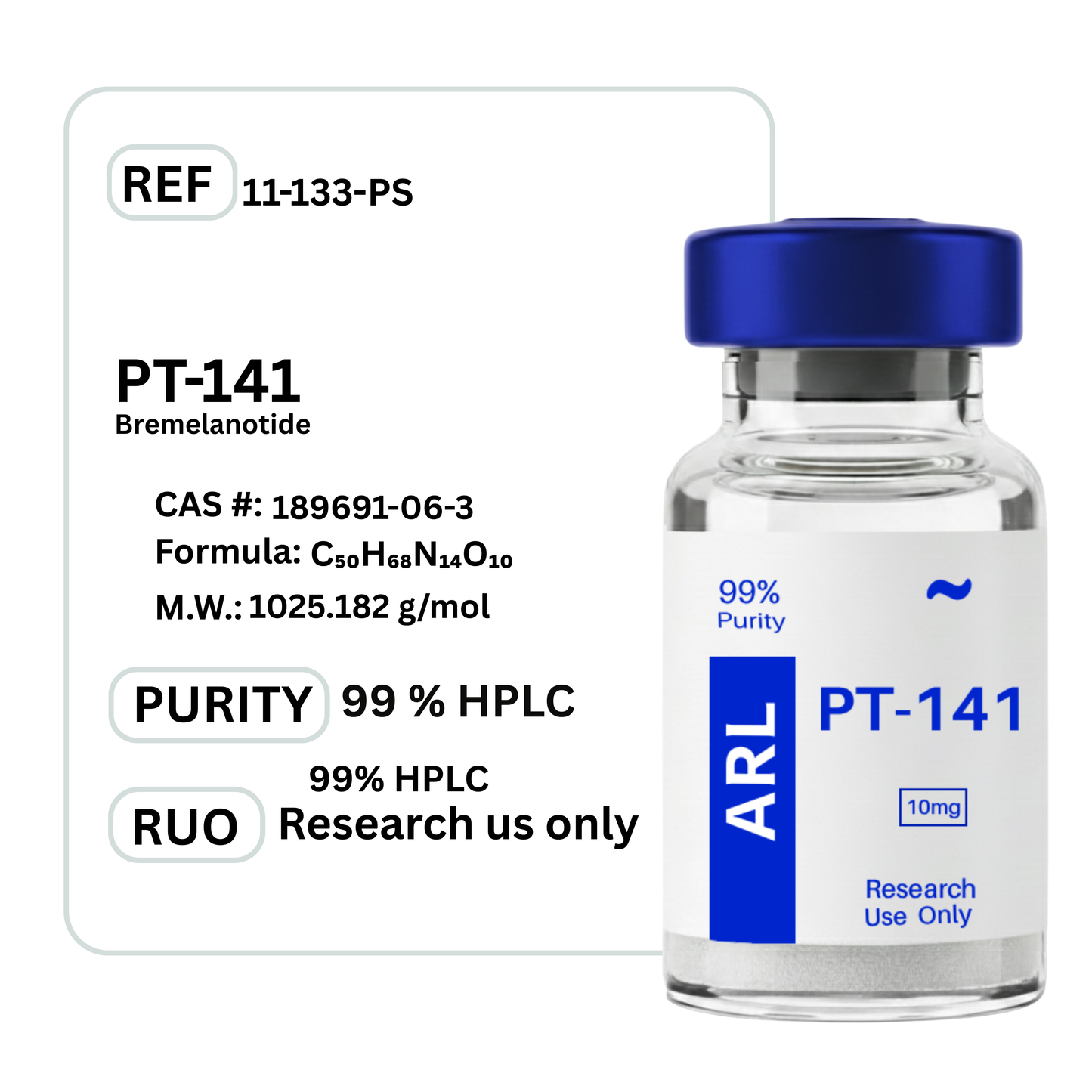
Stabilized PT-141 (Lyophilized) - Stability, Storage, and Reconstitution Guide for Laboratory Managers
1. Introduction to Stabilized PT-141
This document serves as a comprehensive guide for laboratory managers regarding the handling, storage, and reconstitution of our Stabilized PT-141 (Lyophilized) product. Adherence to these best practices is crucial for maintaining product integrity, ensuring research quality, and extending the shelf life of the peptide.
2. Product Overview and Highlights
Stabilized PT-141 is a synthetically derived cyclic peptide. The cyclic structure is specifically designed to enhance resistance to enzymatic degradation, which is a common challenge with linear peptides. This stabilization significantly improves its bioavailability, particularly when administered via nasal or subcutaneous routes, making it a superior choice for research applications requiring optimized delivery.
Feature
Detail
Product Name
Stabilized PT-141 (Lyophilized)
Chemical Class
Cyclic Peptide
Key Benefit 1
Enhanced Resistance to Enzymatic Degradation
Key Benefit 2
Optimized Nasal/Subcutaneous Bioavailability
Intended Use
For Laboratory Research Only
3. Storage Best Practices: Lyophilized Product
Proper storage of the lyophilized (freeze-dried) material is the primary step in ensuring long-term stability and research efficacy. Environmental factors such as temperature, humidity, and light must be strictly controlled.
3.1. Short-Term Storage (Up to 4 Months)
For immediate or near-term use, the lyophilized material offers remarkable stability under controlled conditions.
- Temperature: Stable for 3-4 months at room temperature (20-25°C).
- Vial Integrity: Keep the product in its original, tightly sealed vial with the septum intact.
- Protection: Store in a cool, dark place to minimize exposure to light and moisture.
3.2. Long-Term Storage (Beyond 4 Months)
To preserve the biological activity and purity of the peptide for extended periods, cold storage is mandatory.
- Temperature: Store at ultra-low temperature, specifically -80°C.
- Freezing/Thawing Cycles: Avoid repeated freezing and thawing, as this can degrade the product. We recommend aliquoting the material prior to long-term storage if multiple, small-volume withdrawals are anticipated.
- Documentation: Implement a robust inventory system to track storage location, dates, and handling records.
4. Reconstitution Protocol and Guidelines
Reconstitution, the process of dissolving the lyophilized powder in a solvent, is a critical step that must be performed precisely to ensure the stability of the solution.
4.1. Choice of Solvent
The solvent used for reconstitution directly impacts the solution's stability and sterility.
- Recommended Solvent: Use sterile Bacteriostatic Water for Injection (BWFI), which typically contains 0.9% Benzyl Alcohol. The bacteriostatic agent helps inhibit the growth of common bacteria, extending the useful life of the reconstituted solution.
- Aqueous Buffers: The peptide is highly soluble in aqueous buffers, which may be used depending on the specific research application (e.g., pH 7.4 Phosphate-Buffered Saline, PBS). However, for standard stock solutions, BWFI is preferred.
4.2. Handling and Mixing Techniques
Improper mixing can lead to aggregation, denaturation, and reduced efficacy.
- Dissolution: Slowly introduce the solvent into the vial, allowing it to drip down the side of the glass.
- Mixing: DO NOT VORTEX. Vortexing introduces high shear forces that can damage peptide structure. Gently swirl the vial until the white lyophilized cake is fully dissolved. Complete dissolution may take a few minutes.
- Concentration: Calculate the exact volume of solvent needed to achieve the desired stock concentration prior to reconstitution.
5. Storage Best Practices: Reconstituted Solution
Once reconstituted, the peptide solution is significantly more susceptible to degradation than its lyophilized form.
5.1. Storage Conditions
- Temperature: Store the reconstituted solution in a refrigerator at 2-8°C.
- Shelf Life: Use the reconstituted solution within 30 days of mixing. After 30 days, residual activity may be compromised, and the solution should be discarded.
- Labeling: Vials must be clearly labeled with the peptide name, concentration, date of reconstitution, and the initials of the laboratory personnel who prepared the solution.
State
Storage Temperature
Stability/Shelf Life
Recommended Solvent
Lyophilized (Short-Term)
Room Temperature (20-25°C)
3-4 months
Not applicable
Lyophilized (Long-Term)
-80°C
Extended Preservation
Not applicable
Reconstituted
2-8°C (Refrigerated)
Use within 30 days
Bacteriostatic Water
6. Product Specifications and Quality Control
Our Stabilized PT-141 is manufactured and rigorously tested to meet high purity standards essential for reliable laboratory research.
6.1. Purity and Analysis
The quality of the peptide is confirmed using advanced analytical techniques.
- Purity: Greater than 98% (HPLC). High-Performance Liquid Chromatography (HPLC) is used to verify the purity and quantify any potential impurities.
- Appearance: The product presents as a white lyophilized cake. Any discoloration or deviation from this appearance upon receipt should be immediately reported to the supplier.
- Identity Confirmation: The molecular mass and structure are confirmed using Liquid Chromatography-Mass Spectrometry (LCMS).
Specification
Result
Method
Purity
>98%
HPLC
Physical Form
White Lyophilized Cake
Visual Inspection
Identity
Confirmed
LCMS
7. Safety and Handling
This product is intended solely for laboratory research purposes. It is not for human or veterinary use.
7.1. General Laboratory Guidelines
- PPE: Always wear appropriate Personal Protective Equipment (PPE), including a lab coat, gloves, and eye protection, when handling the product.
- Waste Disposal: Dispose of all solutions, glassware, and consumables in accordance with the laboratory's established hazardous waste protocols. Consult File SOP for Chemical Waste Disposal for detailed instructions.
- Spills: In the event of a spill, follow the lab's chemical spill protocol. Isolate the area, wear proper PPE, and use an appropriate absorbent material.
8. Troubleshooting Common Issues
This section addresses potential issues that may arise during reconstitution and storage.
Issue
Potential Cause
Solution
Powder not dissolving
Insufficient mixing, Cold solvent, Aggregation
Gently swirl the vial longer. Allow solvent to reach room temperature before use. Ensure no vortexing occurred.
Solution appears cloudy
Contamination, Precipitation, pH issue
Check solvent quality and pH. If cloudy, do not use and discard the solution.
Degradation/Loss of Efficacy (within 30 days)
Improper storage temperature (e.g., left out at RT), Repeated freezing/thawing
Verify refrigerator temperature (2-8°C). Review log of handling events. Ensure proper Calendar event Training on Peptide Handling was completed.
9. Inventory Management and Tracking
Effective inventory management is essential for stability tracking and compliance.
9.1. Documentation Checklist
Laboratory managers should ensure the following documentation is meticulously maintained for each batch:
- Certificate of Analysis (COA) file: File PT-141 Batch COA
- Date of receipt and storage location.
- Reconstitution date, concentration, and volume of solvent used.
- Name of the researcher responsible for reconstitution.
- Expiration Date: For lyophilized product, use the date on the COA; for reconstituted solution, use the date 30 days after reconstitution.
9.2. Location Tracking
The main stock of long-term storage peptide should be logged in the centralized inventory system.
- Location of Stock: -80°C Freezer, Unit Place, Shelf Place
10. Glossary and Contact Information
10.1. Glossary
- Lyophilized: Freeze-dried; a process used to preserve a material by removing water.
- HPLC: High-Performance Liquid Chromatography; an analytical technique used to separate, identify, and quantify components in a mixture, ensuring high purity.
- LCMS: Liquid Chromatography-Mass Spectrometry; used to confirm the identity and molecular weight of the peptide.
- Bacteriostatic Water: Sterile water containing a preservative (usually Benzyl Alcohol) to inhibit bacterial growth.
10.2. Contact Information
For technical support, COA requests, or any questions regarding the stability, storage, or reconstitution of Stabilized PT-141, please contact:
- Technical Support Lead: Person
- Email: Person@researchlabs.com
- Phone: (555) 555-Person
- Office Hours: Monday-Friday, 9:00 AM - 5:00 PM PST
11. Appendix: Detailed Reconstitution Procedure (Page 1 of 2)
Required Materials:
- Stabilized PT-141 Lyophilized Vial
- Sterile Bacteriostatic Water for Injection (BWFI)
- Sterile Syringe (appropriate volume) and Needle
- Alcohol Prep Pads
- PPE (Gloves, Lab Coat, Eye Protection)
Procedure:
- Preparation: Ensure all materials are sterile. Place the peptide vial and BWFI bottle in the laminar flow hood.
- Safety Check: Don appropriate PPE. Verify the peptide's identity and concentration requirements from the research plan.
- Calculate Volume: Determine the exact volume of BWFI required to achieve the desired stock concentration (e.g., if the vial contains 5 mg of peptide and the desired concentration is 2 mg/mL, you would need 2.5 mL of BWFI).
- Aseptic Technique: Clean the rubber stopper of the peptide vial and the BWFI bottle with an alcohol prep pad and allow them to air dry completely.
- Draw Solvent: Using the sterile syringe, draw the calculated volume of BWFI from the bottle.
12. Appendix: Detailed Reconstitution Procedure (Page 2 of 2)
- Add Solvent: Slowly and carefully inject the BWFI into the peptide vial. Aim the needle tip against the inner wall of the glass vial so that the water runs gently down the side, avoiding direct forceful injection onto the lyophilized cake.
- Dissolution (Crucial Step): DO NOT SHAKE OR VORTEX. Gently swirl the vial in small, circular motions. The white cake should dissolve relatively quickly. Continue swirling until the solution is completely clear with no visible particles.
- Labeling: Apply a label to the newly reconstituted solution immediately. The label must include:
- Peptide Name: PT-141
- Concentration: [Calculated Concentration]
- Date Reconstituted: Date
- Expiration Date (30 days from reconstitution): Date
- Technician Initials: Person
- Storage: Transfer the labeled vial to the designated refrigerator location (2-8°C). Record the reconstitution event in the laboratory logbook or inventory tracking system.
- Documentation: Save the remaining File Peptide Documentation for future reference.
End of Document