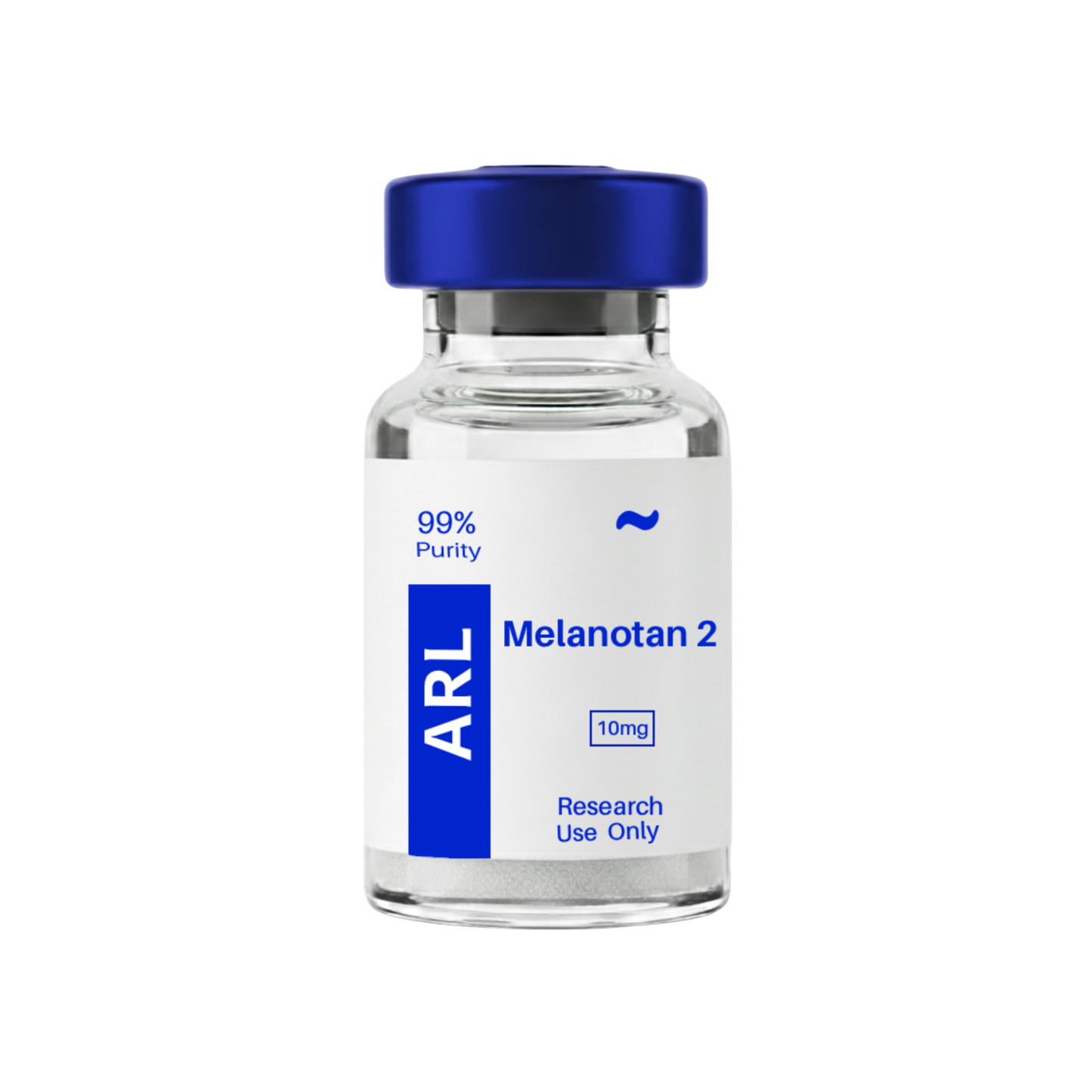
Melanotan II (Lyophilized) - Stability, Storage, and Reconstitution Guide for Laboratory Managers
1. Introduction and Product Overview
This guide is specifically designed for laboratory managers and supervisory personnel responsible for the handling, storage, and preparation of Stabilized Melanotan II (Lyophilized) within research settings. Adherence to these protocols is critical for maintaining the product's integrity, purity, and efficacy throughout its intended shelf life.
Product Highlights
Melanotan II is a synthetic analog of the naturally occurring alpha-melanocyte-stimulating hormone ($\alpha$-MSH).
- Classification: Cyclic Peptide
- Design Rationale: Engineered to be resistant to enzymatic degradation, resulting in an extended half-life in relevant research models.
- Molecular Structure: The cyclic structure provides enhanced stability compared to linear peptide forms.
- Intended Use: For Laboratory Research Only. Not for human therapeutic or diagnostic use.
2. Product Specifications
The following specifications confirm the quality and chemical characteristics of the Stabilized Melanotan II (Lyophilized) product upon shipment.
Characteristic
Specification
Purity
>99% (HPLC)
Counter Ion
Acetate
Appearance
White lyophilized cake
Solubility
Soluble in water and saline
Container Type
Sealed glass vial
3. Storage Best Practices: Lyophilized Form
The lyophilized (freeze-dried) form of Melanotan II provides superior long-term stability when stored correctly. Maintaining a consistent temperature and minimizing exposure to moisture are the primary factors in preserving the product's integrity.
3.1. Short-Term Storage (Up to 4 Months)
For immediate use or during active experimental periods:
- Temperature: Room temperature (20°C to 25°C).
- Duration: Stable for 3-4 months.
- Environment: Store in the original sealed container, protected from light and humidity.
- Note: Minimize the number of times the material is brought out of controlled storage to prevent temperature fluctuations.
3.2. Long-Term Storage (Extended Preservation)
For maintaining maximum stability and purity beyond 4 months:
- Temperature: Ultra-low temperature storage at -80°C.
- Procedure: Transfer unopened vials directly to the -80°C freezer immediately upon receipt.
- Documentation: Ensure the storage location and date of receipt are logged in the laboratory inventory management system. File
Storage Condition
Max Duration
Key Requirement
Room Temperature
3-4 months
Sealed container
-80°C
Extended (Years)
Ultra-low freezer
4. Reconstitution Procedures
Reconstitution transforms the stable lyophilized cake into an injectable solution suitable for in vivo and in vitro research applications. The choice of solvent significantly impacts the stability and sterility of the resulting solution.
4.1. Recommended Solvent
- Solvent: Bacteriostatic Water for Injection (Bacteriostatic Water).
- Rationale: Contains 0.9% Benzyl Alcohol, which acts as a preservative, inhibiting the growth of most common contaminating bacteria. This is crucial for maintaining sterility over the 30-day usage window.
4.2. Reconstitution Steps
- Preparation: Bring the lyophilized vial to room temperature (if stored at -80°C) to prevent condensation.
- Solvent Measurement: Use a sterile syringe to accurately measure the required volume of bacteriostatic water to achieve the desired working concentration (e.g., 1 mL for a 10 mg vial for a 10 mg/mL stock).
- Injection: Slowly inject the bacteriostatic water down the side of the vial, ensuring the stream does not directly hit the lyophilized cake with excessive force.
- Dissolution: Do not vigorously shake. Gently swirl or roll the vial between the palms of the hands until the white lyophilized cake is fully dissolved and the solution is clear. This usually takes only a few minutes.
- Labeling: Immediately label the reconstituted vial with:
- Concentration (File)
- Date of Reconstitution (Date)
- Expiration Date (30 days from reconstitution)
- Preparer's Initials (Person)
5. Storage Best Practices: Reconstituted Solution
Once Melanotan II is reconstituted, its shelf life is drastically reduced due to the presence of water and the initiation of degradation processes.
5.1. Temperature Control
- Temperature: Refrigerated storage at 2°C to 8°C.
- Location: Store in a dedicated pharmaceutical or scientific refrigerator. DO NOT FREEZE the reconstituted solution, as this can denature the peptide structure.
5.2. Stability and Expiration
- Usage Window: Store at 2-8°C and use within 30 days of reconstitution.
- Documentation: Strictly adhere to the 30-day limit. Any remaining solution must be discarded according to institutional protocols after this window.
Product Form
Storage Temp
Max Duration
Solvent
Lyophilized
-80°C
Extended
N/A
Reconstituted
2°C to 8°C
30 days
Bacteriostatic Water
6. Stability and Degradation
6.1. Mechanism of Degradation
The primary mechanisms for peptide degradation in aqueous solution include:
- Oxidation: Degradation of methionine or tryptophan residues.
- Hydrolysis: Breakdown of the peptide bond, primarily accelerated by non-ideal pH levels.
- Deamidation: Modification of asparagine or glutamine residues.
- Aggregation: Formation of insoluble peptide clumps, often induced by surface contact or vigorous shaking.
6.2. Strategies for Maximizing Stability
- pH: The product is formulated to optimize pH upon reconstitution, but the use of non-approved solvents (e.g., tap water, non-sterile saline) can compromise stability.
- Mechanical Stress: AVOID vigorous shaking during reconstitution and handling. Utilize gentle swirling only.
- Light Exposure: Minimize exposure to UV and strong ambient light. Store reconstituted vials in light-protective containers (e.g., aluminum foil wrap or opaque racks).
7. Bioavailability and Administration in Research Models
While this is a guide focused on product handling, understanding the intended administration route is crucial for appropriate preparation.
7.1. Recommended Research Route
- Subcutaneous (SC) Profile: Melanotan II exhibits an excellent pharmacokinetic profile when administered subcutaneously in research models, leading to high bioavailability and reliable systemic exposure.
7.2. Poor Bioavailability Route
- Oral Bioavailability: Low oral bioavailability has been observed in various research models, consistent with typical peptide characteristics, which are prone to degradation by gastrointestinal proteases. Oral administration is therefore generally discouraged for systemic research.
8. Safety and Disposal
8.1. Laboratory Safety
- Handling: Always wear appropriate Personal Protective Equipment (PPE), including lab coats, gloves, and eye protection, when handling the lyophilized powder or the reconstituted solution.
- Spills: In the event of a spill, contain the material immediately. Clean the area using a suitable disinfectant and absorbents. Consult the Safety Data Sheet (SDS) for detailed spill protocols. File
8.2. Waste Disposal
- Unused Material: Expired or unused lyophilized powder and reconstituted solution should be disposed of as hazardous chemical waste, following the specific guidelines of the institution and local regulations.
- Containers: Used vials, syringes, and sharps must be collected in approved sharps containers for incineration or other appropriate disposal methods.
9. Inventory and Quality Control Logging
A rigorous inventory system is essential for monitoring stock levels, ensuring use within stability windows, and facilitating quick identification in case of a product quality alert.
9.1. Inventory Log Data Points
Laboratory managers must ensure the following data is captured for every unit:
Data Point
Responsibility
Status/Example
Lot Number
Receipt & QC Team
File
Date Received
Inventory Manager
Date
Storage Location
Lab Technician
-80°C Freezer, Rack C
Date of Reconstitution
Researcher
Date
Final Concentration
Researcher
10 mg/mL
Expiration Date
Researcher
Date
9.2. Troubleshooting and Quality Concerns
Any deviation from the expected 'White lyophilized cake' appearance or 'Clear, colorless' reconstituted solution must be immediately reported to the Quality Control Manager, Person. Do not use the material if visible degradation (e.g., discoloration, significant clumping) is observed.
10. Contact and Reference
For technical inquiries regarding stability data, quality certificates, or detailed chemical specifications, please contact the Product Support Team.
- Product Support Contact: Person
- General Inquiries: [Email Address]
- Meeting Link for Technical Review: Calendar event
11. Appendix: Dilution Examples
To assist researchers, common dilution tables are provided. All dilutions must use sterile, approved solvents.
Desired Concentration (mg/mL)
Volume of Solvent for 10mg Vial
Volume of Solvent for 5mg Vial
10 mg/mL
1.0 mL
0.5 mL
5 mg/mL
2.0 mL
1.0 mL
1 mg/mL
10.0 mL
5.0 mL
12. Training Requirement
All personnel handling this product are required to review this guide and complete the annual Peptide Handling and Storage Training module. Access the training module here: File. The next mandatory training session is scheduled for Date at the Place auditorium.
13. Regulatory Statement
Stabilized Melanotan II (Lyophilized) is sold strictly for research purposes. It is the responsibility of the purchaser to ensure that their use of the product complies with all local, state, and federal laws and regulations.
14. Document Revision History
Revision Number
Date
Author
Description of Change
1.0
Date
Person
Initial Release
1.1
Date
Person
Clarified long-term storage temperature
1.2
Date
Person
Added Bioavailability section
1.3
Date
Person
Updated safety and disposal guidelines
1.4
Date
Person
Added training section
15. Standard Operating Procedure (SOP) Reference
This guide serves as a supplement to the lab's official SOP for peptide handling. Refer to SOP-PEPTIDE-File for detailed sterile technique and lab-specific safety measures. All laboratory managers must maintain an updated copy of the SOP at their station in Place.